I feel kind of silly posting this since I've been working on these things for near 50 years. But -just the same I'm curious if anyone else with a 1010 has had this problem. I'm at the point where I may just start changing parts to see if something works.
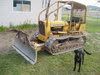
I've had this 1010 crawler loader for 15-20 years. It's always been a poor starter in cold weather below 30 degrees F, but otherwise it's been fine. Once running - it runs absolutely perfect. I rebuilt the engine when I first got it, mainly because it had been in a fire. Distributor was melted and I had to buy a used Delco. Ran it for two years not knowing it was a 6 cylinder distributor with a four cylinder cap stuck on it. That caused some weird problems ! Ends up it was from a Deere 4010, not a 1010. Had a six-lobe points cam. So, I found a very rusty four-lobe cam from a Case tractor and that fixed those particular weird problems. But the cam is very rusty and pitted and wears down points rubbing blocks pretty quick.
Note - a four cylinder engine runs pretty good with a six cylinder distributor but does some very strange things. One is severe carbon tracking and burning out caps very quickly.
So, since I've had it, it has never had the complete original ignition system -but I never figured it mattered. OEM it would of had a ballast resistor built into the key swith, a low-ohm 6 volt type coil, and a cranking- resistor-bypass built into the key switch to allow full voltage to the coil which cranking.
I installed a standard battery key switch, 6 volt low-ohm coil, external ballast resistor, and a cranking- bypass wirred to the Delco starter. I assume Deere did NOT do this since some 1010s had Prestolite starters and they do not have the bypass feature.
I used the crawler this way for many years. Then recently I started getting a problem that once good and hot after running for hours, the engine would just quit. If I let it sit for a few minutes it would start right up and sometimes run fine for hours. Or - sometimes just quit aqain. Seems to be some sort of intermittent ignition problem. I was always able to restart so I never spent much time trying to diagnose.
This spring I had a big pond project and I knew I'd be using the 1010 a lot. In fact, I literally ran the tracks off it. Before the project, I decided to install a Pertonix breakerless kit. I do NOT believe all the wonderous BS stories about engines running better with Pertonix. I did it to elimate points wear only. The reason was that the four-lobed cam in the distributor was in bad shape and was hard on points. By using the breakerless module, I eliminated the rusted-pitted cam. But - the Pertonix "Ignitor" kit does not allow use of a low-ohm 6 volt type coil unless a resistor is wired in. It will void warranty. So for simplicity, I bought a brand new high-ohm "12 volt" coil. 3.2 ohms instead of 1.5 ohms on the primary. Afterwards I ran the crawler almost all day, every day for two weeks and it ran flawlessly. But this was an unusual warm spell and it never got colder then 60 degrees F. Now the weather has cooled down -into the 30s and 40s F. The crawler is near impossible to start. I tried widening the plug gap from .025' to .035" and it made no difference. If anything, it might be worse. I tried altering the timing and no changes made any difference. Sometimes I have to fool with it for half an hour and finally it will start. When it does it runs perfect. Note - the choke on the carb works fine. In fact it's pretty easy to flood. This problem seems to be a "yes" or "no" sort of thing. No inbetween. I tried checking spark during the time when it was not starting. With a plug wire hooked to a plug (with ground electrode broken off), and cranking it - it threw a good spark jumping near 1/4". So I'm stumped when it comes for further diagnosis. I DO know that it takes more energy to make a spark inside a combustion chamber so my open-air test is not perfect. I think now I'm going to start changing parts.
One piece of evidence though. One time after cranking for half an hour - I removed one spark plug. I then cranked and it started right up - even though it only had 3 cylinders. So what did removing one plug do? I assume cranking speed increased since the compression of one cylinder was missing. I then put the plug back in and checked actual voltage to coil when cranking. Voltage goes down to 8 volts. So I'm now wondering if maybe this Pertonix breakerless module has a sort of "yes" or "no" threshhold when voltage drops below a certain point - or cranking speed drops below a certain RPM. To add to this maybe my starter is drawing more current then it ought to resulting in the voltage drop to 8 volts when cranking? Seems it ought to only drop to 9 or 9.5 volts, not 8 volts. It is NOT a cable or connection problem Even drops to 8 when checked at the battery.
I do know this. This 1010 starts much better with the former 6 volt coil with ballast resistor and breaker-points. Obviously with the 6 volt type coil - as the 1010 came new - and the cranking bypass - 8 volts at cranking is plenty.
Right now I suspect the Pertronix as the issue. When I bought it I was planning to use a low ohm 6 volt type coil. After opening the box I was surprised to find out it can’t be used with any coil less then 3.2 ohms or it will burn out. This is the standard Ignitor.
1010 gas starting problem - long boring post
-
waterman28
- 430 crawler

- Posts: 65
- Joined: Tue Apr 20, 2010 10:11 am
- Location: Spokane, Washington
In my opinion 8 volts while cranking is too low. If this is a 12 volt system you should have 9.2-9.6 volts at the battery min while cranking. Load test battery after a good 12 hour charge and see what the voltage drop is. Check to see what kind of amps your starter is drawing while cranking.
JD 1010 Crawler
Ferguson TO 30
Case 580C
996 David Brown
Ferguson TO 30
Case 580C
996 David Brown


Hi John-
I have never used a Pertronix on my tractors and crawlers but had done some research, and the consistent theme I have seen online from people posting their issues is that you have to be sure that the Pertronix is always getting as close to full 12V as possible and that they are very sensitive to bad grounds.
Outside of the Pertronix, when I have had issues with intermittent firing (with new coil, distributor cap, etc.) is a bad ignition switch or bad insulator on the small coil to distibutor wire.
Hope this gives you some food for thought- although I am sure you have probably ran through most if not all of these possibilities already.
I have never used a Pertronix on my tractors and crawlers but had done some research, and the consistent theme I have seen online from people posting their issues is that you have to be sure that the Pertronix is always getting as close to full 12V as possible and that they are very sensitive to bad grounds.
Outside of the Pertronix, when I have had issues with intermittent firing (with new coil, distributor cap, etc.) is a bad ignition switch or bad insulator on the small coil to distibutor wire.
Hope this gives you some food for thought- although I am sure you have probably ran through most if not all of these possibilities already.
(1) JD Straight 450 crawler dozer with manual outside blade; (2) JD 2010 diesel crawler loaders; (1) JD 2010 diesel dozer with hydraulic 6-way blade; (2) Model 50 backhoe attachments, misc. other construction equipment
-
jdemaris
This crawler was in a fire 20 years ago. That's how I wound up buying it. It was a low-hour machine owned by the guy that bought it new. Burned up and everything non-metal melted. So soft metal parts also metal. When I pulled the starter - I replaced the brushes, brush holders, bushings, drive, solenoid, etc. The fields and insulation looked good at the time - but I've always suspected them of being somewhat damaged and causing excessive current draw. I've used it 20 years since and the starter has always worked BUT often sounds like it's laboring and working against itself. I never checked cranking voltage until now. In the back of my mind, I always figured sooner or later I'd come across a used 1010 gas starter somewhere and fix as a spare. But it never happened. Funny thing since there was one on Ebay a few days ago and the listing expired with no bids. $49 I could of had it for (plus $15 shipping). I didn't bid because I figured it would get run up over $100 like most everything else on Ebay. I wish somebody make aftermarket parts for the 1010s. For my 1020 diesel - I just bought a brand new (not rebuilt) gear reduction starter for $95 - tax free and shipped to my door. That is a great deal.waterman28 wrote:In my opinion 8 volts while cranking is too low. If this is a 12 volt system you should have 9.2-9.6 volts at the battery min while cranking. Load test battery after a good 12 hour charge and see what the voltage drop is. Check to see what kind of amps your starter is drawing while cranking.
I'll gave to look more seriously in getting a starter OR maybe trying to find new field coils somewhere. I don't know if they are still available or not.
-
Brockway761
- 420 crawler

- Posts: 37
- Joined: Mon Feb 20, 2012 12:46 pm
-
Brockway761
- 420 crawler
- Posts: 37
- Joined: Mon Feb 20, 2012 12:46 pm
-
jdemaris
The vast majority of tractors, cars, and trucks with breaker points use what you're calling a "6 volt coil."Brockway761 wrote:Hi, I was just wondering why is there a 6 volt coil on a 12 volt system? I thought someone had used the wrong coil on my 1010 as it also has a 6 volt coil and a 12 volt generator?
In a 6 volt system the coil is powered directly from the battery. So when cranking it gets around 4.5 volts and when running it gets around 7 volts.
In a 12 volt system, often the same coil is used but when running it is powered through a resistor to lower running voltage. Also has a system that allows full battery voltage only when cranking. So when cranking the "6 volt" coil gets around 9.5 volts. When running and system voltage rises to 14 volts - it runs through a resistor and runs the coil on 7-8 volts.
Generally speaking, what is being called a "6 volt coil" will measure around 1.2 to 1.5 ohms on the primary windings. A coil often called a "12 volt only" coil will measure 3 to 3.5 ohms across the primary windings.
-
Brockway761
- 420 crawler
- Posts: 37
- Joined: Mon Feb 20, 2012 12:46 pm
-
jdemaris
No it should not be marked "12 volt." 1010 uses the same coil as a 420 crawler with a 6 volt system.Brockway761 wrote:Okay, so with the stock 1010 wiring system the coil should not have 12v printed on it when using a 12 volt battery?
1010 DID come with four different ignition systems though. Wico, Prestolite, and two Delco versions. They all used low-ohm coils and ignition resistors. Early on those resistors were built into the special ignition switch. Later Deere sold an external, remote-mount resistor kit.
-
Brockway761
- 420 crawler
- Posts: 37
- Joined: Mon Feb 20, 2012 12:46 pm
Who is online
Users browsing this forum: No registered users and 4 guests